Getting to Know Your Fascia
By Dillon Rasley, LMT, BSN

Understanding the potential role of fascia in perceived muscular pain begins with comprehending both superficial and deep/muscular fascia, their differences, and their connection to muscular function, signaling, and information transmission. Increasing research highlights the crucial roles that deep fascia (the dense, fibrous connective tissue enveloping skeletal muscle and the individual muscle fascicles comprising it) plays in both proprioception (awareness of body position and movement) and nociception (the perception of pain). Superficial fascia, a layer of loose connective tissue situated between the superficial and deep adipose layers just beneath the skin, has only recently been acknowledged as its own distinct anatomical structure. It is now also recognized for its roles in exteroception (stimuli originating from outside the body) and nociception.
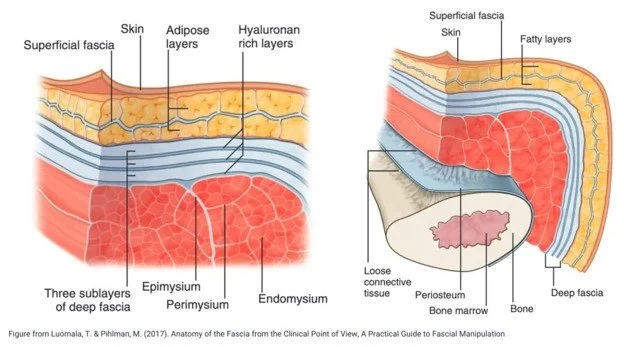
Healthy fascia should feel smooth and possess a high level of elasticity, enabling the muscle bundled within it to move mostly freely. Fascial adhesions, however, can restrict muscle mobility and cause painful "knots" to develop in the muscle. Determining whether pain is caused by a fascial or muscular pathology can be challenging. One distinguishing sign that the sensation of muscular pain is fascia-related is that it tends to diminish with increased movement and responds well to heat. In contrast, strict muscle or joint pain tends to worsen with movement. This is because fascia has thixotropic properties, which allow it to transition from a denser, stiffer state to a more fluid, elastic state when exposed to heat and multidirectional stretching. When left untreated, these adhesions can worsen, compressing the underlying muscle and resulting in trigger points that then refer pain to seemingly unrelated parts of the body. Techniques such as myofascial massage, trigger point therapy (TPT), direct heat therapy, and rebound or ballistic movements are effective in reducing and correcting fascial adhesions and treating the associated symptoms.
Maintaining healthy fascia involves several approaches. One is to engage in varied physical activity throughout the day to prevent fascia from becoming rigid. Avoid prolonged periods in the same position, such as sitting for hours. Regular stretching also helps maintain the elasticity and suppleness of fascia, enabling its free function. Activities like yoga and foam rolling can be extremely effective as well. Foam rolling works best when the area is warmed first with a soak or heating pad. Acupuncture can also help. Lastly, be mindful of postural habits that may put excessive strain on the fascia and underlying musculoskeletal system.
Treating fascial adhesions and related muscular pain may require patience, but adopting a comprehensive, multifaceted approach can effectively reduce or eliminate the chronic pain these issues can cause if left untreated. If your pain lingers despite these self-care steps, it may be time to see a professional who can assess and treat the underlying fascial restriction directly. We are here to help.
References
Fede, C., Petrelli, L., Pirri, C., Neuhuber, W., Tiengo, C., Biz, C., De Caro, R., Schleip, R., & Stecco, C. (2022). Innervation of human superficial fascia. Frontiers in Neuroanatomy, 16, 981426. https://doi.org/10.3389/fnana.2022.981426
Suarez-Rodriguez, V., Fede, C., Pirri, C., Petrelli, L., Loro-Ferrer, J. F., Rodriguez-Ruiz, D., De Caro, R., & Stecco, C. (2022). Fascial innervation: A systematic review of the literature. International Journal of Molecular Sciences, 23(10), 5674. https://pmc.ncbi.nlm.nih.gov/articles/PMC9143136/
Fan, C., Pirri, C., Fede, C., Guidolin, D., Biz, C., & Stecco, C. (2022). The deep fascia and its role in chronic pain and pathological conditions: A review. Clinical Anatomy, 35(5), 649-659. https://pubmed.ncbi.nlm.nih.gov/35417568/
An emerging perspective on the role of fascia in complex regional pain syndrome: A narrative review. (2025). PubMed Central. https://pmc.ncbi.nlm.nih.gov/articles/PMC11942918
Johns Hopkins Medicine. (n.d.). Muscle pain: It may actually be your fascia. https://www.hopkinsmedicine.org/health/wellness-and-prevention/muscle-pain-it-may-actually-be-your-fascia
